3.2.3 Axon Initial Segment
”Neurons ensure the directional propagation of signals throughout the nervous system. The functional asymmetry of neurons is supported by cellular compartmentation: the cell body and dendrites (somatodendritic compartment) receive synaptic inputs, and the axon propagates the action potentials that trigger synaptic release toward target cells. Between the cell body and the axon sits a unique compartment called the axon initial segment (AIS)”[54]. In the light of the new experimental and theoretical results, we need to add new components, roles and operating modes to the one assumed by the present physiology.
Also we must add the invention from about three decades later: ”Neurons ensure the directional propagation of signals throughout the nervous system. The functional asymmetry of neurons is supported by cellular compartmentation: the cell body and dendrites (somatodendritic compartment) receive synaptic inputs, and the axon propagates the action potentials that trigger synaptic release toward target cells. Between the cell body and the axon sits a unique compartment called the axon initial segment (AIS). The AIS was first described 50 years ago [i.e., nearly two decades after HH published their study], and its molecular composition and organization have been progressively elucidated during the following decades. …. Recent years have also brought crucial insights into the functions of the AIS: how ion channels at its surface generate and shape the action potential.” [54] We provide the physics and mathematics of how AIS shapes the action potential (or more precisely, we show what an important role it plays in forming AP).
In our model, the AIS gets independent from the membrane, and this separation leads to crucial changes. (BTW, the name is misleading: the AIS is part of the neuronal oscillator, and it forwards a traveling potential wave to the axon instead of belonging to it.) ’Although by definition a neuron must have an axon to assemble an AIS, the relationship between AIS assembly and axon specification in vivo has not been determined yet’ [51].
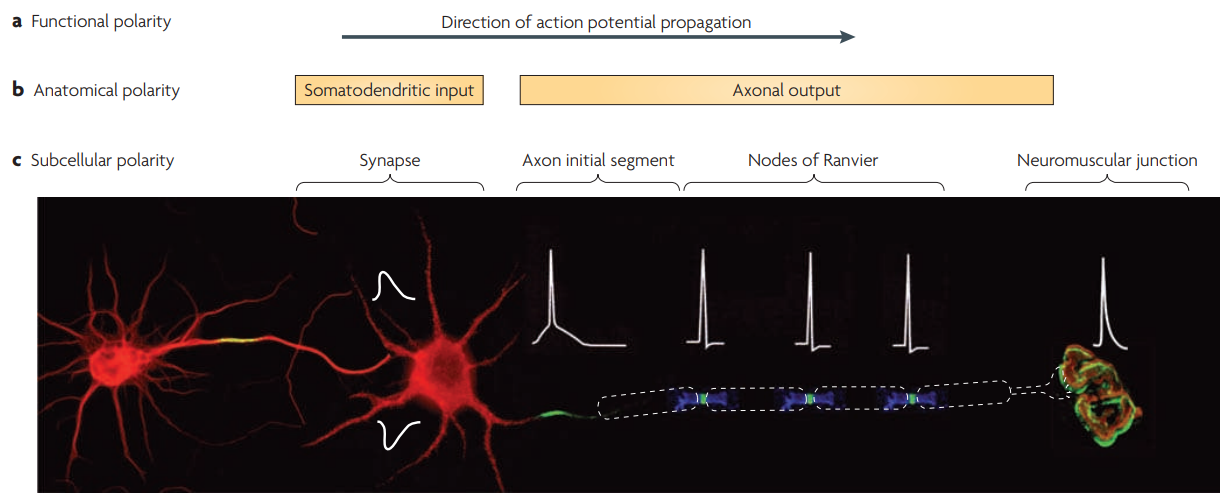
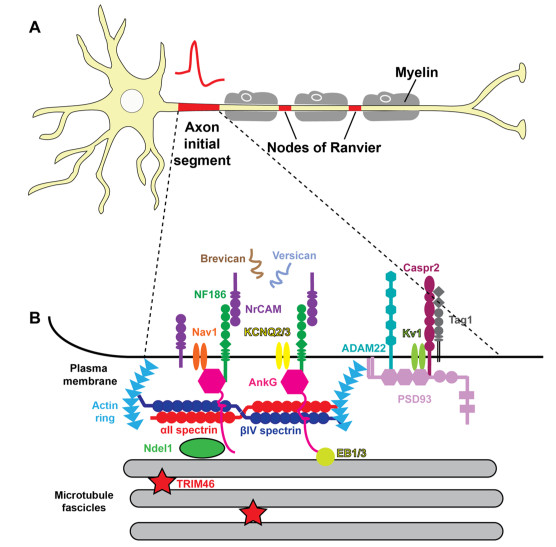
”The axon initial segment (AIS) is located at the proximal axon and is the site of action potential initiation. This reflects the high density of ion channels found at the AIS. … The summation of synaptic inputs gives rise to action potentials at the axon initial segment (AIS), a 20–60 long domain located at the proximal axon/soma interface that has a high density of voltage-gated ion channels.” As discussed in [77], see also their Figure 1, reproduced here as Figure 3.3, the structure of the Axon Initial Segment is known to the smallest details. As the illuminating investigations in 2008 [50] revealed, the AIS has very dense ion channels. That is, from an electrical point of view, those parallelized channels can be abstracted as a discrete conductance (or resistance) between the membrane and the axon. The membrane itself can be abstracted as a distributed condenser with no resistance (in contrast with the viewpoint of biophysics, that the membrane plus AIS is considered a distributed element, where the capacitor and condenser cannot be separated). Notice the important point: ”Neurons are also anatomically polarized, as they can be subdivided into a somatodendritic input domain and an axonal output domain” [51]; providing a direct evidence that (unlike in HH’s model) the input and output currents (and voltage time derivatives) are independent, see also Fig. 3.4. More precisely, they form the input and output of a neuronal oscillator, as our model suggests. Notice how the AP changes its shape during its propagation in the adjacent segments, as our model explains: the broadening by axonal arbor, the voltage-gradient generated shape on the AIS, the appearance of iAPTD at the distant junction. Notice the lack of hyperpolarization at the beginning and end of the pipeline; a clear effect of of the neuronal oscillator. Inventing AIS changed the viewpoint of neuroscience [54].