3.8 Hodgkin&Huxley’s empirical description
As we discuss in section 2.5, the body’s electric signals were discovered early, the principles, notions and technical equipments have been elaborated. Even, some meticulous measurements correctly interpreted some of its signals. The development of electronical technology enabled their systematic study in the beginning of the 50’s. However, experimenters often forgot that ”Under ideal circumstances, the physical act of measuring a neurophysiological event would have no effect on the electrical signal of interest. Unfortunately, this is seldom the case in neurophysiology.” [2].
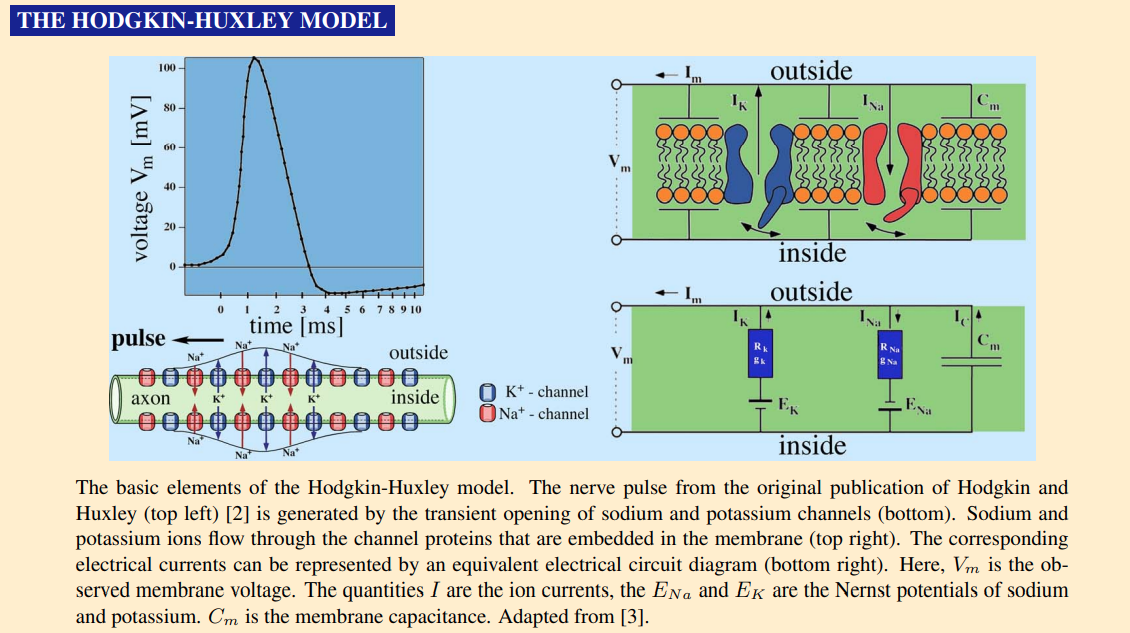
The first systematic attempt to describe the results of observations in terms of well-known laws of electricity was published around 1952 [9]. A collection of their (modernized) papers is available [76]. They made a huge amount of meticulous measurements and wanted to help the science community with providing equations for practical applicability. To speed up reaching that goal, they introduced empirical functions and derived equations, which, not surprisingly, described the empirical observations quite accurately. The importance of their work is best highlighted by that it inspired different disciplines for discussion.
Quotation: ”although highly successful in predicting and explaining many of the electric characteristics of the action potential, the HH model, nevertheless cannot accommodate the various non- electrical physical manifestations (mechanical, thermal and optical changes) that accompany action potential propagation, and for which there is ample experimental evidence. [35]
A technical reason is described in [148]: ”The fact that the whole process for calculation of a interval, showing the initiation of and recovery following an action potential, could be accomplished in 8 hours is astonishing.” The must-be oversimplification does not belong to the core of the theory. When using the recent computing systems, not necessarily the old oversimplified models should be coded. One could also use modern, more compute intensive, and physically correct models.
Model summary
Self-evaluation
In their brilliant publication [9], Hodgkin and Huxley evaluated their results ”that our equations [must not be taken as] anything more than an empirical description” and ”the [partial] success of the equations is no evidence in favour of the mechanism”. When validating their observations, they have found serious question marks: ”a number of points were noted on which the calculated behaviour of our model did not agree with the experimental results. We shall now discuss the extent to which these discrepancies can be attributed to known shortcomings in our equations.” ”One was that the membrane capacity was assumed to behave as a ’perfect’ condenser, …the other was that the equations governing the potassium conductance do not give as much delay in the conductance rise on depolarization as was observed in voltage clamps”. They did have the intuition that something was wrong and they correctly guessed its reason: ”it seems difficult to escape the conclusion that the changes in ionic permeability depend on the movement of some component of the membrane which behaves as though it had a large charge.…it is necessary to suppose that there are more carriers and that they react or move more slowly …there is no evidence from our experiments of any current associated with the change in sodium permeability, apart from the contribution of the sodium ion itself”.
They emphasized that their work ”must not be taken as evidence that their equations are anything more than an empirical description”. They made the first step of ”a great journey into the unknown” and were very cautious by saying that ”the success of the equations is no evidence in favour of the mechanism that they tentatively had in mind when formulating them”.
In his late work [148], Hodgkin evaluated the filtered experiences: ”We soon realized that the carrier model could not be made to fit certain results, for example the nearly linear instantaneous current voltage relationship, and that it had to be replaced by some kind of voltage-dependent gate. As soon as we began to think about molecular mechanisms it became clear that the electrical data would by themselves yield only very general information about the class of system likely to be involved. So we settled for the more pedestrian aim of finding a simple set of mathematical equations which might plausibly represent the movement of electrically charged gating particles.”
Nobel-laudation
Unfortunately, they also attempted to understand which physical processes happen in the membrane, but they concluded with the feeling that ”the interpretation given is unlikely to provide a correct picture of the membrane.” Despite their explicite warning, that ”the success of the equations is no evidence in favour of the mechanism that we tentatively had in mind when formulating them”. Despite, they received the Nobel-prise ”for their discoveries concerning the ionic mechanisms involved in excitation and inhibition in the peripheral and central portions of the nerve”. As the philosphical approach to their work discusses, ”One could dismiss this curious passage as scientific modesty if it were not for the fact that Hodgkin and Huxley argue for their conclusions.” [44] The science community rushed to apply the equations, instead of validating them. To compensate for the disagreements with the experimental data, further ad-hoc assumptions have been introduced, making their admittedly wrong picture even worse.
In the sense of philosophy, ”there is a widely accepted distinction between merely modeling a mechanism’s behavior and explaining it. The equations must be supplemented by a causal interpretation: one might, for example, agree by convention that the effect variable is represented on the left, and the cause variables are represented on the right, or one might add “these are not mere mathematical relationships among variables but descriptions of causal relationships in which this variable is a cause and this other is an effect,” and not vice versa”, for more details see [44, 149]. The lack of causality is one reasons why HH have had the feeling they missed the correct picture of the membrane. The other reason is that some fine details of their oversimplified picture was not accurate, althought the additional (and arbitrary) ad-hoc assumptions have hidden the disagreements. The followers have ”fitted elephants” [30] by adding many more ad-hoc effects with too many parameters.