3.2 The physical model
As Figure 3.1 summarizes: ”Electrical signals travel from the cell body of a neuron (left) to its axon terminal in the form of action potentials. Action potentials trigger the secretion of neurotransmitters from synaptic terminals (upper insert). Neurotransmitters bind to postsynaptic receptors and cause electric signals (synaptic potential) in the postsynaptic neuron (right). Synaptic potentials trigger action potentials, which propagate to the axon terminal and trigger secretion of neurotransmitters to the next neuron.” Furthermore, the ”neurons convey neural information by virtue of electrical and chemical signals”[2]. These sentences should read that ions carry the observed potential changes and that the signal propagation is low. Notice that at that time it was not yet recognized that the electric signals propagate with a finite speed also in the dendrites, not only on the axons.
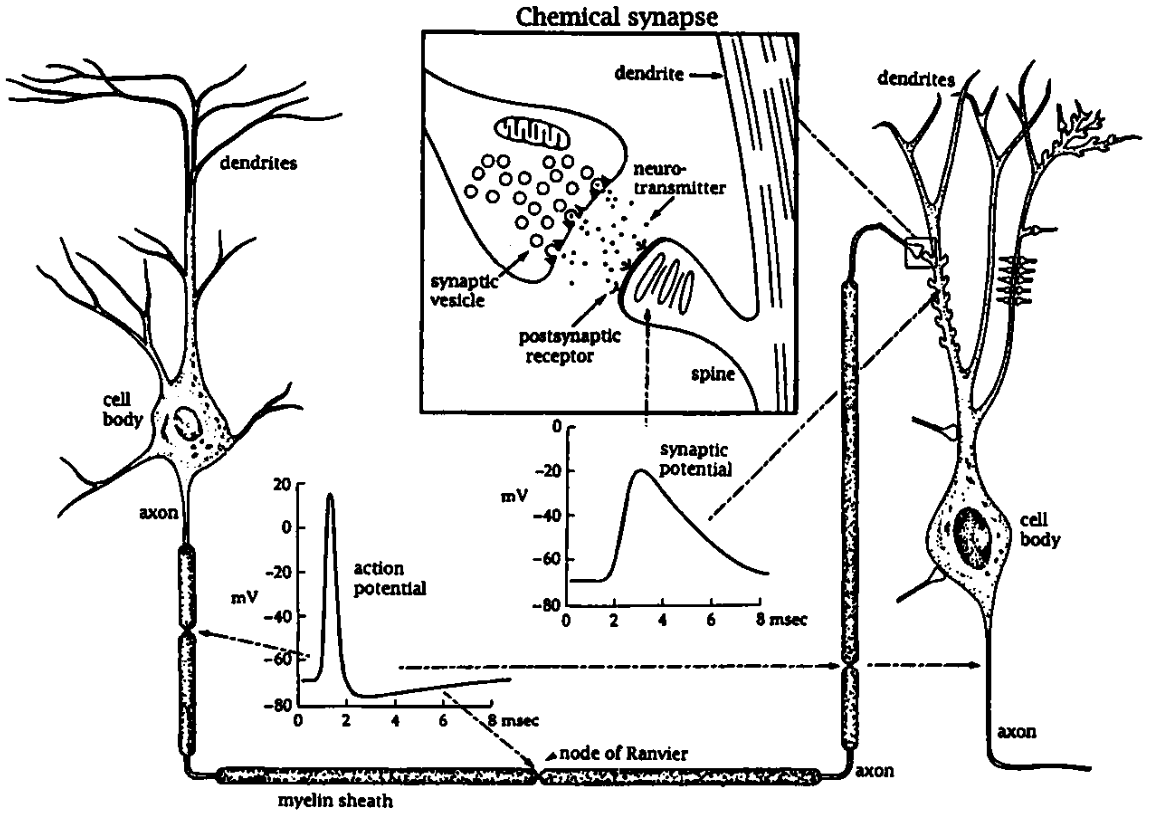
Basically, we follow the Johnston&Wu’s ”general principles. As in general in science, we must introduce different abstractions and approximations for describing nature, see section 2.2. Making a model for neuron represents a special challenge. As one of the simplest biological entities, the neurons interface the non-living and living science, furthermore, the microscopic and macroscopic world.
We must be very cautious with modeling the electrical features. ”an understanding of the electrical properties of dendrites is critical for evaluating the errors associated with the electrophysiological measurements of synaptic function”.
???The two conditions imply that we must use slow currents. As we discuss in sections 2.5.2 and 2.5.3
”Electrotonic is a rather arcane term that is used to describe passive electrical signals, that is, signals (current or voltage) that are not influenced by the voltage-dependent properties of the membrane. It will become obvious that this theory is too simple to explain the complexities of dendrites, but at least it is a good starting point.” [2] In other words, that model is usable only for a static description, ”it is too simple”, but there is no commonly used other idea. Unfortunately, in physiology, the interrelations expressed by the Onsager-relations remain entirely out out scope; presumably primarily because of the lack of laws of motions of thermodynamics. The chemical concentration and the electrical potential is only loosely connected, and only statically and for the bulks of cellular segments.