3.7.1 The classic picture
Quotation:
”there is little hope of calculating the
time course of the sodium and potassium conductances from first principles”
(surely, if one uses empirical functions)
[9]
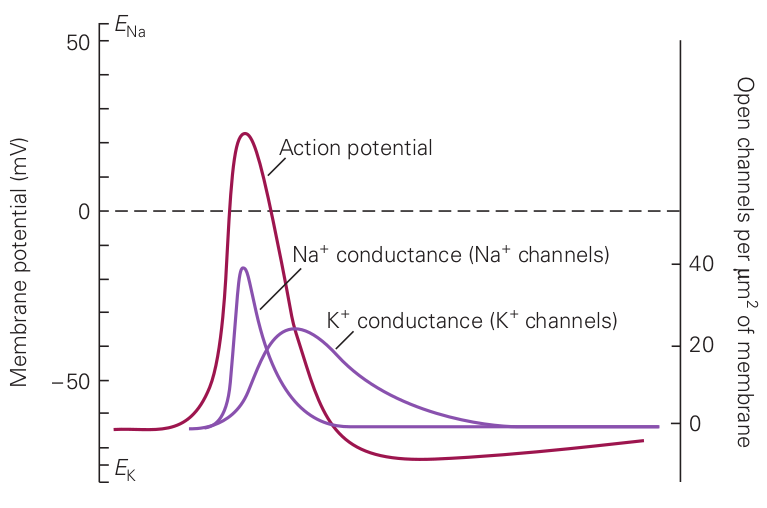
In the classic picture, we assume that the membrane is equipotential.
When the axonal input current charges it up to some threshold value,
an intense charge-up process starts due to ion inflow. After the
membrane’s voltage exceeds some other threshold, a spike begins. After
some time, and for some reason, az outward “delayed rectifying current”
starts from some hidden source and hyperpolarizes the membrane. Somewhat
later, both currents stop, in a concerted way, for some reason. In
the classic approach, a spike is sent and received instantly (an incoming
spike “makes a hole” [81]),
the charge it delivers is added to the membrane in a snap, and
the neuron fires in a snap somewhat later. The process details are
known (although some processes are only hypothesized, and others are
misunderstood). However, the control mechanism of the process
is unknown or mystic: the classic model answers the question ”what”
but leaves the questions of type ”whyänd ”how” open. “Why
action potentials are initiated in the axon is still unclear” [50].