2.3.1 Electrical measurement
The difficulties of performing electric measurement on living matter were known since the beginnings: ”Since it is quite generally believed that the depolarization of a nerve fiber membrane, during excitation and propagation, involves an increased permeability to ions there have been many attempts to detect and to measure this change as an increase in the electrical conductivity. … In these cases the measuring current was also the stimulating current and it was not possible to analyze the changes satisfactorily.” [43] It is worth to recall that performing an electric measurement on the operation of some electric system always represents an intervention into the electric process of the system under study; the question only is how much the measurement influences those operating processes. Measuring the conductance of an isolating membrane, with ion channels in its wall and slow ions flowing in its surface layers, is one of the hardest measuring tasks. We discuss below some fine differences compared to measuring in metals. We interpret the notions precisely below.
When measuring electric resistance (or conductance), we need:
-
•
Charged objects that can be moved, the charge carriers
-
•
An electric field that moves the charge carriers
-
•
No other field (such as concentration gradient) that moves the charge carriers
-
•
A medium that ’resists’ moving the charge carriers
If an electric potential is applied to an ionic solution, the cations of the solution are drawn to the electrode that has an abundance of electrons, while the anions are drawn to the electrode that has a deficit of electrons. The movement of anions and cations in opposite directions within the solution amounts to a current. Notice that the current inside the electrolyte is represented by ions, in the rest of the electric circuit, by electrons; the electrode must convert the charge carrier. The electrode actively participates in the process (even if it is a measurement), and its operation takes time. Recall that the current delivered by the ions means at the same time a change in concentration (transport of material). If the ions can freely change their position, after some relaxation time, the driving forces due to the electric charge and the concentration balance each other as the Nernst-Planck equation describes.
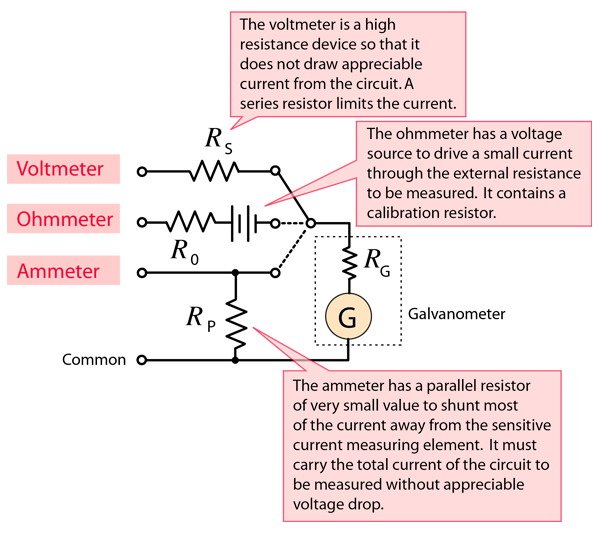
The electric measurement means an intrusion into the measured system. To measure voltage and current (we call them secondary entities), we can minimize the intervention. However, to measure conductance, we must generate charge inside the measured system (see Fig. 2.2): we must apply some voltage to the medium and measure the current with which the medium responds; that is, a foreign voltage falsifies the measurement result. The fact is known in neurophysiology (but either forgotten or not understood), see [2], section A.3.12: ”(input impedance) can be measured by applying a voltage and measuring the resulting current or by injecting a current and measuring the resulting voltage”. We often forget that we concluded the notion for metals and that if the number of moved charge carriers changes during the measurement (see section 2.5.3), or a ”foreign” (not considered) force field also affects the object, our measurement will produce fake results; see for example electromagnetic forces and the decades-long history of memristors [111]. Moreover, we assumed an isotropic medium (unlike complex biological objects). The current may delay, disappear, and re-appear in an improperly designed measurement. It is not against the laws of physics; it is due to the incomplete knowledge of physics.
A ”conductance meter” device actively applies a potential that affects the measured object. It assumes that the tested object is passive (also in the sense that switching that field on causes no structural change in the medium) and it is in a field-less stationary electric state. The device calculates the displayed result as if the object were metal and no foreign current or voltage was present. For active components (the measured object actively reacts to the applied voltage, and even for resistors used in actively working electric circuits), it provides fake measurement results: it calculates resistance/conductance using Ohm’s Law from its input data that contains ”foreign” current contribution(s).
It is frequently forgotten that the mentioned processes ”produce” electric charge in the measured system. Measuring conductivity actually means measuring current, see section 2.5.2. Somehow, researchers forgot this warning and attibuted the created charge to some changed conductivity. In the case of a biological membrane, no charge carriers are present in its resting state. However, the applied voltage may open voltage-controlled ion channels, and the field may move the ions through them. The device sees its own effect: the voltage it applies generates an ion inflow, moves the ions it produces, and measures the resulting output current. Recall Eq.(2.28): the current grows as the number of charge carriers increases; a real danger when measuring conductance in the presence of ion channels. Different devices and different settings provide different conductance values for the same membrane. It is a systematic error due to the incomplete understanding of the physics of electric measurements. See Fig. 6 in [9] at high clamp voltage, the device’s voltage contribution is insignificant. However, it is at least comparable to the measured effect at low clamp voltage. (Assuming a resting conduction in axons is a self-contradiction. To have conduction, free charge carriers need to be present, which means the presence of ions inside the axon, that means potential above the resting potential. Those ions flow out to the galvanically connected membrane. The measurement device generates the ”resting conductance” attributed to axons and membrane.)
Furthermore, one must forget to make parallels with the single-speed electric circuits, especially using their ready-made equations (used outside their range of validity) assuming a voltage generator. Biological circuits are different: their voltage continuously changes due to material transport and the currents are a million times slower. Biological interactions are governed by more complex laws, especially if interactions at enormously different speeds play a role. However, like in the case of modern versus classic physics, the first principles can provide good hints in the limiting case. If we face a controversy, we apply the wrong basic assumptions and omissions/approximations.
Ohm’s Law is valid only in its differential form but not in integral form. The charge, whether injected artificially or natively through the synapses into the membrane, needs time to travel from their entry point to their exit. The two definitions are equivalent only if the current’s speed is infinitely large (instant interaction) or in other words, it does not depend on the time; furthermore, if the driving force is constant and purely of electrical origin. The non-differential definition fixes current and makes material’s features variable. The wrong definition rejects known laws of physics and introduces new laws which it does not define. It rejects the first principles of science and introduces empirical laws without understanding them. The misunderstanding arises from using the wrong abstraction of ”electrical node”. In classical electricity, the abstraction ’instant interaction’ means that the node is discrete and sizeless. Kirchoff’s law implies that the current enters and exits the node simultaneously, which is not the case in biology. It is a self-contradiction: the change in the current’s time course (a charge-related electric entity) is transferred to the medium. Due to the wrong definition one simply divides non-matching data value pairs and attributes the effect of the wrong definition (using inappropriate abstraction of ”instant interaction”) to the process under study. It is the source of a series of misunderstandings and directs physiology towards a wrong direction (it did not ask: why charge conservation is not valid). In classical electricity, in the world of ’instant interaction’ the Kirchoff’s law is a good approximation (but correct books also mention that on a piece of wire there exist a . However, the case is different in physiology: the speed of current is in the range of ; there is a ”phase delay” between the voltage and the current.