1.7.2 The implementation of the ActionPotential
As we discussed in connection with Fig. 1.5, fundamentally the neuron is electrically balanced and for small perturbations, it control mechanisms return its state to the dynamically balanced resting state. To produce an AP, the neuron uses a voltage-dependent ”ion-production” mechanism (its ”structure differs from anything we tested in physical laboratories”. As physiology observed, a large amount of ions rush into the intracellular segment. They cause a sudden increase in the local potential of the proximal layer of the membrane. The potential creates a considerable combined gradient across the AIS, and an intensive current starts to flow. Due to the ions’ low speed, the current needs time to reach the AIS, Actually, a discharge process takes place. Given that the charges are created over the finite-size surface of the membrane, charges from different positions arrive at different times (although they were created at the same time): a smeared double-exponential current appears on the AIS However, the mebrane with its capacitance and the AIS with its resistance forms a serial oscillator (one of the catastrophic fallacies in neorophysiology is to hypothesize the circuit is parallel distorts the shape to what can be measured by physiology.
In a special type of invasion, when suddenly a large amount of rushes in (i.e., the trigger is external, but the ions derive from a biological process), the current throughput of the ”resting ion channels” is not sufficient anymore: the instant increase of concentration drastically increases, and so does the membrane’s potential. At that point, the neuron is out of balance: although most of the ions can flow out through the AIS, the system also changes its concentration through the limited capacity ”resting ion channels” until the balanced state regained. This latter effect must not be mismatched with the capacitive current, which (due to its changed direction) causes the phenomenon known as ”hyperpolarization”.
Figure 1.8 shows the schematic course of potentials and concentrations during issuing an AP. Follow the green path: the concentration ratio of and ions define a thermodynamic contribution in the intracellular segment. Follow the blue path: the and ions define a thermodynamic contribution in the extracellular segment.
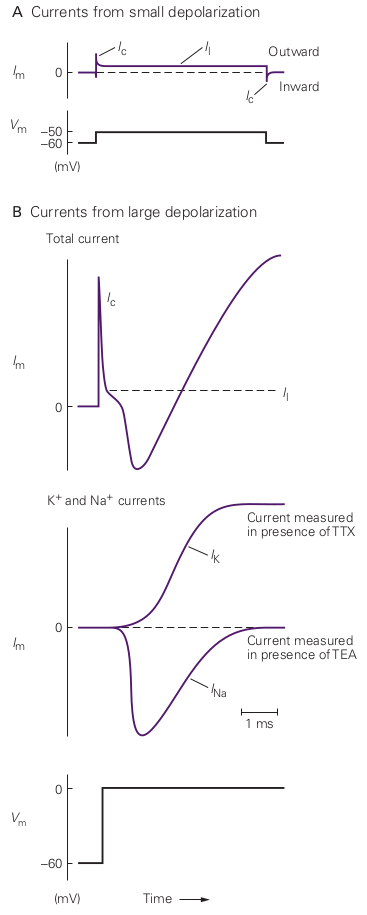
Notice the two-sided negative feedback effect: a change in the value of the ”command potential” or ”command concentration” changed the other value. In the case of voltage invasion, the ratio of the ion concentrations also changes. In this case, the feedback amplifier is the delicate balance of the electric and thermodynamic force fields. In the case of clamping, another (electric) feedback amplifier is introduced into the system and they work against each other. The neuron attempts to restore its balance without external potential (it cannot distinguish the foreign potential from its membrane potential), and changes its concentrations accordingly. A vital difference is the speed of the feedback amplifier. The electrical one works with electric speed, while the thermodynamic one with the several orders lower thermodynamic speed. When switching (or changing) the external (”command”) voltage, the neuron must first get into its ”steady state”. It takes time. ”The command potential, which is selected by the experimenter and can be of any desired amplitude and waveform” [41]. However, if the measured data readings are not from a steady state, the measurement is wrong: the different amplifier speeds (different current speeds) surely distort the measured value. Compare the figure to Fig. 2.5
On the left side, two positive ions are in the solution, and the membrane potential (due to charge separation) rises toward the outside segment; the ions cannot go ”uphill”. Similarly, the ions cannot go uphill (due to their negative charge, the same potential is also rising for them). This single membrane potential keeps all ions in their segments. However, the ions can travel ”downhill”. Calcium pumps needed: although in minimal concentration, ions flow into the intracellular segment, and they must be pumped out. (BTW: this is also the reason why measuring concentration is inaccurate.)
As we discussed above, the concentrations and voltages in the extracellular segment, with its vast amount of ions, remain unchanged in resting and transient states. Follow the red path: when ions rush into the intracellular segment; they increase the concentration from to (say) . This sudden change decreases the thermal contribution of potential to , but because the total charge on the membrane significantly increases, the resulting voltage on the intracellular side of the membrane increases to . The neuron could decrease its potential to the resting value if it could decrease concentration to . However, the ion delivering capacity of the ”resting ion channels” is not sufficient: they are sized to maintain the resting state. (Furthermore, the electric contribution appears instantly, while the thermodynamic one, due to the finite speed of ions, only with some delay [22].) Follow the dashed orange path: the large amount of rush-in ions drastically increases the surface concentration on the membrane, so the potential suddenly changes to . Follow the dotted orange path: the electric field of the membrane suddenly changes its direction from positive slope to negative so that the excess positive ions can move ”downhill” out of the intracellular space through the high-capacity ion channel array (AIS) at the end of the neuron. Its internal end is at the high membrane potential, while the external end is at the low potential of the extracellular segment.
Given that the outer concentrations are unchanged, so is the membrane potential. The system must preserve its balanced state under the constraints that the inside sum of concentrations of the positive ions remains the same while the outside concentrations of all ions remains unchanged change according to Eq.(1.2). That is, we have a sum concentration and the dependence of on
| (1.3) | ||||
| (1.4) |
that enables us to derive in function of (i.e., what concentration can keep the balance with the given concentration):
The other way round is that by knowing all concentration values, we can calculate the voltage on the membrane:
This enables us to draw the membrane’s voltage at different concentrations, as hown in Fig.
The set-point on the extracellular side remains fixed. On the intracellular side, initially, the actual voltage is above the set-point on the extracellular side, so at the two ends of the AIS, a positive driving force moves the ions toward the downstream neuron. However, the charge on the membrane continuously decreases and consequently, the voltage slope increases and the current through the membrane decreases. At some point, the voltage drops below the set-point of the extracellular side. The neuron continues restoring its set-point on the intracellular side, but now the resulting potential across the membrane is reversed. The resulting potential continues having a larger positive slope, so the direction of the reversed current grows. At this stage, most of the rushed-in charge has flown out, so the driving force decreases and a low-intensity current restores the balanced state, to the previous set-point. When measuring at the AIS, one observes that the potential rises suddenly, then decreases below the set-point (hyperpolarizes the membrane), than a decreasing current (flowing in the opposite direction due to the changed slope of the resulting potential, but comprising the originally rushed-in ions) slowly restores the resting potential. Here comes to light the finite speed of ions again. The ions can follow the potential changes with a delay due to their finite speed, causing an apparent delay in the time course of the AP’s current.